"When the stars make you drool just like pasta e fagiole, that's amore." -- Dean Martin
There's nothing in the world quite like a good homemade tomato sauce -- a delicacy which I was raised to call "gravy." The texture, the taste, the catharsis of chopping and peeling and stirring the ingredients, and the way it makes your house smell on a Sunday morning all defy description. And since I feel like everyone should be able to make a decent tomato sauce from scratch and feel the joy of it for themselves, I'm going to share my family's recipe with all of you.
Unlike many of the recipes I post here, this one will be delivered in paragraph form. I can't supply exact quantities of ingredients or give you an abbreviated description of the motions because I don't cook my gravy that way. A few posts ago, I described the essence of Italian cooking as simple and classic with clean flavors and a focus on seasonal items, but in retrospect, that isn't a complete definition. Italian cooking also involves community -- the random cousins and neighbors who bring you figs, cucuzza, and fresh bread for no reason, the army of paisanos in the kitchen helping you to prepare the ingredients, the second army who shows up for dinner, the third army who shows up for dessert. Every meal is a conversation from start to finish, so a conversation is how I'll teach you to prepare one.
First, you find yourself a gravy pot. I like to use an insanely heavy, three-gallon, yellow enamel pot I inherited from my great-grandmother, but anything big will do just fine. (I'm investing in one of these once the yellow one finally wears out.) Next, you choose your tomatoes. I think plum tomatoes make pretty excellent gravy, but it's up to you. In any case, estimate how many you'll need by filling your pot with whole tomatoes.
When you get all those tomatoes home, wash them and cut a big X into the smooth end of each one. Fill your pot with water and turn the burner on high. Fill a big bowl with ice water and set it next to the stove. When your water is boiling raucously, drop in your tomatoes a few at a time. After about a minute -- when the skin has started to peel near the Xs -- scoop them out of the boiling water and plunge them into the ice water. You can remove them and set them aside once they're cool to the touch. Once all of your tomatoes have been boiled and shocked, dump out and dry your pot and your bowl so you can reuse both. Peel all the tomatoes, remove and discard all the seeds and stems, and break up the flesh into some semblance of a puree (either by mashing or food-processing). Place the puree back into the big bowl and set aside.
I've done this much a grand total of once in my life. Nine hundred and ninety-nine times out of a thousand, I buy two boxes of Pomi strained tomatoes (or one big can of San Marzano crushed tomatoes) and use that instead of pureed fresh tomatoes. It's the exact same thing, only Pomi does the hard work for us.
The rest of the instructions assume that you're using about six cups of pureed tomatoes for your gravy, so scale as needed. Mince one medium white onion and sautee it in a generous amount of olive oil over medium heat in the big pot until the pieces start becoming translucent. Add five minced cloves of garlic and continue sauteeing until everything starts to brown. I like to add a little bit of minced pancetta, prosciutto, or anchovy here for flavor, but you can omit that. Once everything is nicely browned, deglaze with a cup of marsala wine or dry sherry. Let some of the alcohol boil off and add your tomatoes. Stir in six or seven torn-up fresh basil leaves, two pinches of oregano, and a pinch of black pepper, then lower the heat a little and cover. Cook for at least two hours, stirring every ten minutes or so. As it cooks, the gravy will darken and thicken. This recipe yields enough gravy for a pound of the pasta of your choice (plus a little extra), and if you're not planning on feeding an army, it freezes exceptionally well.
This makes a lovely plain marinara sauce, but, of course, you can transform it by adding meats or vegetables to the pot along with the garlic. Add diced red pepper and a little bit of cayenne for a romesco sauce, tuna or crab meat and a little chili powder (with parsley swapped for the basil) for seafood gravy, mushrooms or eggplant or spinach for a vegetable gravy (or all three for a modified puttanesca sauce), or, of course, crumbled-up sausage, chopmeat, or meatballs for traditional meat gravy. You'll want to cook your vegetables until they're soft and cook your meat until it's browned before deglazing.
It may seem like a lot, but it becomes second-nature after a while. And really, jarred sauce can't compare.
Sunday, August 31, 2008


Friday, August 29, 2008
The Odd Couple
"You're not at all the funny, awkward little girl I knew. Oh no! I was mad not to have seen the change in you. When did your sparkle turn to fire and your warmth become desire?" -- Alan Jay Lerner
As you all know, I'm a trained geek working as a geek. And though I've always recognized different breeds of geekery in society, it took a comment on this blog for me to recognize different brands of geekery within myself. A few days ago, Red remarked that my posts tend to show off my dorkiest colors. I always have been -- and still am -- a dork, but lately, I seem to have morphed into a new breed of dork.
There's a part of me who lives to get her hands dirty and loves to experiment -- let's call her The Mad Scientist. She thrives is tank tops and Chuck Taylors and thinks best at three in the morning. She's not afraid to use trypan blue as a plaster dye, mix concrete and wood hardener to invent a new type of sealant, pop the lock off of someone else's milling machine to do some impromptu woodcarving, or explode a capacitor or three trying to perfect a wave-generating circuit. She's always the first to pull out a Leatherman, always the fastest to dream up an alternate solution, always the last to settle for something that doesn't look quite right. The Mad Scientist is a little scatterbrained, but she treads that fine line between genius and insanity with practiced precision.
Lately, though, another geek personality is starting to dominate: The Researcher. As the Keeper of the Protocol (or seven), she has no time for imagination. She plays by the rules -- and Lord help you if you don't. She strolls around in a suit and stilettos on most days, calmly handling the affairs of patients and physicians and firmly handling the FDA and the networks. She's perfectly kind and perfectly patient, but she's efficient and super-knowledgeable and isn't afraid to show it. The Researcher commands respect. She double-checks every move she makes and triple-checks every move her colleagues make because, in her world, one mistake can put someone in his coffin.
The Researcher thrives whenever I find myself on the upper east side, but sometimes, The Mad Scientist comes out to play. She emerges whenever the copy machine breaks, whenever an odd piece of code is needed for something, whenever someone needs to know which test tubes contain clotting factors or what metals are MRI-compatible. And though The Researcher is a good person to be in this world, I was The Mad Scientist for so long that I can't help but miss her.
The Mad Scientist was the woman who knew entirely too much about Materials Science in the elevator earlier in the week, and for one beautiful moment, she made everyone forget that she was a mere intruder on The Researcher's workday.
As you all know, I'm a trained geek working as a geek. And though I've always recognized different breeds of geekery in society, it took a comment on this blog for me to recognize different brands of geekery within myself. A few days ago, Red remarked that my posts tend to show off my dorkiest colors. I always have been -- and still am -- a dork, but lately, I seem to have morphed into a new breed of dork.
There's a part of me who lives to get her hands dirty and loves to experiment -- let's call her The Mad Scientist. She thrives is tank tops and Chuck Taylors and thinks best at three in the morning. She's not afraid to use trypan blue as a plaster dye, mix concrete and wood hardener to invent a new type of sealant, pop the lock off of someone else's milling machine to do some impromptu woodcarving, or explode a capacitor or three trying to perfect a wave-generating circuit. She's always the first to pull out a Leatherman, always the fastest to dream up an alternate solution, always the last to settle for something that doesn't look quite right. The Mad Scientist is a little scatterbrained, but she treads that fine line between genius and insanity with practiced precision.
Lately, though, another geek personality is starting to dominate: The Researcher. As the Keeper of the Protocol (or seven), she has no time for imagination. She plays by the rules -- and Lord help you if you don't. She strolls around in a suit and stilettos on most days, calmly handling the affairs of patients and physicians and firmly handling the FDA and the networks. She's perfectly kind and perfectly patient, but she's efficient and super-knowledgeable and isn't afraid to show it. The Researcher commands respect. She double-checks every move she makes and triple-checks every move her colleagues make because, in her world, one mistake can put someone in his coffin.
The Researcher thrives whenever I find myself on the upper east side, but sometimes, The Mad Scientist comes out to play. She emerges whenever the copy machine breaks, whenever an odd piece of code is needed for something, whenever someone needs to know which test tubes contain clotting factors or what metals are MRI-compatible. And though The Researcher is a good person to be in this world, I was The Mad Scientist for so long that I can't help but miss her.
The Mad Scientist was the woman who knew entirely too much about Materials Science in the elevator earlier in the week, and for one beautiful moment, she made everyone forget that she was a mere intruder on The Researcher's workday.
Wednesday, August 27, 2008
Man vs. Beast: IT'S ON!
"Holy Hitchcock, Batman!" -- a coworker
At around 8:30 this morning, I rose from the subway and started my ten-minute walk to clinic. I was halfway there -- on 66th and Third -- when a grey blur divebombed my head.
You guessed it. Columba livia strikes again.
Luckily, today is Wednesday, the day I come to work in comfy pants and flatsbecause all of my reasons for wearing skirts and high heels aren't in clinic on Wednesdays. Thus, this time around, I was able to leap out of the pigeon's way instead of taking the hit.
I walked the remaining distance in utter shock. Later in the morning, I put the story in my Gmail away message and Q immediately sent me this link. Apparently, the Times recently ran an article detailing how crows and certain other avian species can actually recognize, remember, and hold grudges against humans.
I showed the article to a colleague and he thought of Hitchcock. I thought of something else entirely:
At around 8:30 this morning, I rose from the subway and started my ten-minute walk to clinic. I was halfway there -- on 66th and Third -- when a grey blur divebombed my head.
You guessed it. Columba livia strikes again.
Luckily, today is Wednesday, the day I come to work in comfy pants and flats
I walked the remaining distance in utter shock. Later in the morning, I put the story in my Gmail away message and Q immediately sent me this link. Apparently, the Times recently ran an article detailing how crows and certain other avian species can actually recognize, remember, and hold grudges against humans.
I showed the article to a colleague and he thought of Hitchcock. I thought of something else entirely:
Tuesday, August 26, 2008
Landscaping 101
"They took all the trees and put 'em in a tree museum and charged the people a dollar and a half just to see 'em." -- Joni Mitchell
I'm sitting in Rockefeller Center as I write this, and since my Palm TX can't latch onto NBC's wireless signal from this distance, I'm blogging in my little red Moleskine. (Remember the days when keeping a journal meant writing in an actual book with an actual pen and keeping your words private? Ha!) Saks sits on my left and Thirty Rock looms to my right, tourists and stressed commuters mingle in front of me. My ears resound with the bells of St. Patrick's Cathedral and my nose inhales fumes from the M4. ("Clean air bus" my ass.) If one place in this city could completely encapsulate the world's expectation of New York, this would probably be it.
You'll notice that, in the above description, I didn't mention what's behind me. You know what's behind me? A palm tree. A freaking palm tree, towering twenty feet high, its fronds shielding me from the little sunlight left in the day. It's in a marble container along with passion flowers, baobab-looking things, bromeliads, and a few plants with leaves the size of trashcan lids.
I feel like this deserves some sort of insightful comment, some wryly profound observation about the state of a world in which idiosyncracies can sit in marble buckets in the middle of midtown for no apparent reason. And you know what? I'm too captivated by the damn things to think of anything remotely coherent to say.
I'm sitting in Rockefeller Center as I write this, and since my Palm TX can't latch onto NBC's wireless signal from this distance, I'm blogging in my little red Moleskine. (Remember the days when keeping a journal meant writing in an actual book with an actual pen and keeping your words private? Ha!) Saks sits on my left and Thirty Rock looms to my right, tourists and stressed commuters mingle in front of me. My ears resound with the bells of St. Patrick's Cathedral and my nose inhales fumes from the M4. ("Clean air bus" my ass.) If one place in this city could completely encapsulate the world's expectation of New York, this would probably be it.
You'll notice that, in the above description, I didn't mention what's behind me. You know what's behind me? A palm tree. A freaking palm tree, towering twenty feet high, its fronds shielding me from the little sunlight left in the day. It's in a marble container along with passion flowers, baobab-looking things, bromeliads, and a few plants with leaves the size of trashcan lids.
I feel like this deserves some sort of insightful comment, some wryly profound observation about the state of a world in which idiosyncracies can sit in marble buckets in the middle of midtown for no apparent reason. And you know what? I'm too captivated by the damn things to think of anything remotely coherent to say.
Monday, August 25, 2008
Elevator Crystallography
"Livin' it up while I'm goin' down." -- Aerosmith
After an hour of reading scans in the fifth-floor CT suite of the outpatient pavilion, I wait entirely too long for the elevator. When the doors finally open, there's room for one and I gladly occupy it. The car descends one floor, the doors open, and the people on the other side turn away disappointed. It descends another floor and the doors open to reveal a man who looks like a cross between Howdy Doody and an excitable puppy, grinning madly and bouncing on the balls of his feet. Of course, he tries to wedge his way in.
"Come on, people! We're all in this together!" he half-shouts as we all jostle to give him room. "This is a New York elevator! Things can get more dense! It's a matter of engineering!"
This piques my interest, so I shift my bag to buy him a few more inches. He squishes in front of me and the doors close. "Yeah!" he says. "That's it! We've achieved optimal atomic packing!"
"With no vacancies on the lattice," I respond with a smirk.
The man stops bouncing for a moment, tilts his head. "Though it would work better if we were all hexagons," he ventures, his voice tinged with curiosity.
"Or face-centered cubes," I offer.
"Ohhh!" says my sparring partner. "She knows how to play, doesn't she?"
The doors open on the first floor, he spots someone familiar in the lobby, and he bounds off to offer a greeting and a hug. I walk out to 53rd Street to wait for my transport back to clinic.
After an hour of reading scans in the fifth-floor CT suite of the outpatient pavilion, I wait entirely too long for the elevator. When the doors finally open, there's room for one and I gladly occupy it. The car descends one floor, the doors open, and the people on the other side turn away disappointed. It descends another floor and the doors open to reveal a man who looks like a cross between Howdy Doody and an excitable puppy, grinning madly and bouncing on the balls of his feet. Of course, he tries to wedge his way in.
"Come on, people! We're all in this together!" he half-shouts as we all jostle to give him room. "This is a New York elevator! Things can get more dense! It's a matter of engineering!"
This piques my interest, so I shift my bag to buy him a few more inches. He squishes in front of me and the doors close. "Yeah!" he says. "That's it! We've achieved optimal atomic packing!"
"With no vacancies on the lattice," I respond with a smirk.
The man stops bouncing for a moment, tilts his head. "Though it would work better if we were all hexagons," he ventures, his voice tinged with curiosity.
"Or face-centered cubes," I offer.
"Ohhh!" says my sparring partner. "She knows how to play, doesn't she?"
The doors open on the first floor, he spots someone familiar in the lobby, and he bounds off to offer a greeting and a hug. I walk out to 53rd Street to wait for my transport back to clinic.
Sunday, August 24, 2008
Caprese-ious
"Once upon a time I had plenty of nothing, which was fine with me because I had rhythm, music, love, the sun, the stars, and the moon above. Then time went by and now I've got plenty of plenty, which is fine with me because I've still got love and still got rhythm, but look at what I've got to go with 'em!" -- Stephen Sondheim
Every Sunday morning in the late summer, I go out to the backyard to pick tomatoes and basil for the day's meal. I can't use our tomatoes for the gravy -- our plants thrive in joint-compound buckets and don't yield nearly enough fruit for that -- but they're sweet, fleshy, and seedless enough to make excellent caprese salad.
Caprese salad is probably the easiest Italian mainstay imaginable. Slice two tomatoes, arrange the slices prettily on a plate, top with a handful of torn-up fresh basil leaves, slices of mozzarella, and a drizzle of olive oil and balsamic vinegar, and serve. It's simple yet classic, the flavors are clean, and it showcases seasonal items to perfection -- all of which, in my book, illustrate the very essence of proper Italian cooking. And maybe I'm biased, but I prefer caprese salad the way I make it, in its purest form, using tomatoes and basil I grow myself, fresh mozzarella from Rosario's, and olive oil personally pressed by a cousin in Abruzzi.
Unfortunately, my family's balsamic vinegar tastes fell to the mercy of Costco Syndrome: someone bought a million-gallon jug of it somewhere along the line and we lived off of it for far too many years. Then, when I was finally old enough to recognize the syrupy beauty of a good balsamic, I became a poor college student and was forced to live off of economy brands once again. Thus, I became an expert at preparing reductions -- even the nastiest balsamic becomes palatable if you boil it down enough.
 This morning, I prepared my caprese salad with a recent acquisition: fig-infused balsamic vinegar from Oliviers & Co. It's thick, it's syrupy, it's sweet, it's complex, and an eight-ounce bottle of it cost me a quarter of a day's salary. It's far removed from the simplicity of my other ingredients, but it produced the best caprese salad I've ever experienced in my life. It felt incredibly strange pairing such a precious, extravagant ingredient with things I nurtured from seedlings, but it'll be a long time before I resort to reductions again.
Every Sunday morning in the late summer, I go out to the backyard to pick tomatoes and basil for the day's meal. I can't use our tomatoes for the gravy -- our plants thrive in joint-compound buckets and don't yield nearly enough fruit for that -- but they're sweet, fleshy, and seedless enough to make excellent caprese salad.
Caprese salad is probably the easiest Italian mainstay imaginable. Slice two tomatoes, arrange the slices prettily on a plate, top with a handful of torn-up fresh basil leaves, slices of mozzarella, and a drizzle of olive oil and balsamic vinegar, and serve. It's simple yet classic, the flavors are clean, and it showcases seasonal items to perfection -- all of which, in my book, illustrate the very essence of proper Italian cooking. And maybe I'm biased, but I prefer caprese salad the way I make it, in its purest form, using tomatoes and basil I grow myself, fresh mozzarella from Rosario's, and olive oil personally pressed by a cousin in Abruzzi.
Unfortunately, my family's balsamic vinegar tastes fell to the mercy of Costco Syndrome: someone bought a million-gallon jug of it somewhere along the line and we lived off of it for far too many years. Then, when I was finally old enough to recognize the syrupy beauty of a good balsamic, I became a poor college student and was forced to live off of economy brands once again. Thus, I became an expert at preparing reductions -- even the nastiest balsamic becomes palatable if you boil it down enough.
 This morning, I prepared my caprese salad with a recent acquisition: fig-infused balsamic vinegar from Oliviers & Co. It's thick, it's syrupy, it's sweet, it's complex, and an eight-ounce bottle of it cost me a quarter of a day's salary. It's far removed from the simplicity of my other ingredients, but it produced the best caprese salad I've ever experienced in my life. It felt incredibly strange pairing such a precious, extravagant ingredient with things I nurtured from seedlings, but it'll be a long time before I resort to reductions again.
Friday, August 22, 2008
To Diode For
"Electric circuitry is an extension of the central nervous system." -- Marshall McLuhan
Because I have nothing better to do with my time, I made a necklace.

And because I'm a total dork who gets a little too excited over the prospect of playing with electronics, the necklace is made entirely of rectangular light emitting diodes.

It's a little prickly at the moment, but a little lead-free silver solder should fix all the sharp parts easily enough. Keeping my hands steady enough to solder may be a challenge, though, since I'm sure I'll be giggling the whole time.
Because I have nothing better to do with my time, I made a necklace.

And because I'm a total dork who gets a little too excited over the prospect of playing with electronics, the necklace is made entirely of rectangular light emitting diodes.

It's a little prickly at the moment, but a little lead-free silver solder should fix all the sharp parts easily enough. Keeping my hands steady enough to solder may be a challenge, though, since I'm sure I'll be giggling the whole time.
Wednesday, August 20, 2008
Featherbrained
"With all the pigeons in the city in such a small amount of space, I never have contemplated the idea of one actually making contact with me." -- a friend of mine
Not many people know this about me, but I have a crazy talent for ornithology. Though my skills have probably diminished from lack of use, I was once able to identify 160 species of northeastern birds by sight and 70 by sound.
The strangest thing about this incredibly weird skill of mine is the fact that I live in New York City, a place completely devoid of any form of natural wildlife. My metropolis is almost exclusively overrun by a few species of finches, some sparrows, ubiquitous European starlings, an urban hawk or three, and, of course, millions of rock doves.

This is a rock dove. Scientific name Columba livia. Alias feral pigeon or flying rat. They are everywhere in New York City -- in our skies and our trees, under our feet and our air conditioners. But, like tourists and garbage and tall buildings, the average New Yorker barely recognizes their existence. As my friend so memorably stated in the quote immortalized above, we can go years on end without a single pigeon encounter.
Of course, I'm not so lucky. My love affair with these birds began at the ripe old age of five, when one of them shat on me while I was on my way to Kindergarten. And oddly enough, an unfortunate pigeon experience has heralded every new phase of my life ever since.
During my first year of high school, as I sat in a long-since-closed ice cream parlor in Queens with a few of my new friends, a pigeon flew into the shop, smashed into the plate-glass window above my head, knocked itself momentarily unconscious, and landed in my hair. To make matters worse, it got stuck in my rather wild curls when it revived and flapped around for a few moments before finding its way to the door.
Four years later, I began my education at the urban arm of the Ivy League and moved onto a campus full of pigeons with absolutely no fear of humans. They were constantly around my head, in my way, underfoot. I found myself swerving around campus to avoid them, which I thought was utterly ridiculous. One day, as a pigeon moseyed along in front of me as I tried to get to chemistry lecture, I began to wonder if the natural survival instinct ceased to exist in these birds. I pointed my foot, took aim, and gave the damned thing an experimental kick. Feathers scattered, it squawked and flew away. A hippie-looking girl crossing my path stopped and stared at me in abject horror. "Ohmygawd," she yelled, "animal cruelty!" I shrugged, told her the pigeon deserved it, and continued to class.
Four years later, I moved into the workforce and found myself on the upper east side. Yesterday, I got dressed up for work -- short pleated black skirt, black blouse, nude heels that make my legs look ten miles long -- and took a walk down First Avenue during my lunch break. I turned my head to check the traffic, faced forwards again... and spotted a pigeon about to collide, in-flight, with my chest. I raised my arms. It smacked into those instead, ricocheted back a foot, continued flying. I ran back to clinic as fast as my pretty heels could carry me and disinfected the upper half of my body with the same soap the MDs use to scrub into surgery.
Of course, this all leads me to wonder what's next. Watch the pigeons outnumber the guests on my wedding day.
Not many people know this about me, but I have a crazy talent for ornithology. Though my skills have probably diminished from lack of use, I was once able to identify 160 species of northeastern birds by sight and 70 by sound.
The strangest thing about this incredibly weird skill of mine is the fact that I live in New York City, a place completely devoid of any form of natural wildlife. My metropolis is almost exclusively overrun by a few species of finches, some sparrows, ubiquitous European starlings, an urban hawk or three, and, of course, millions of rock doves.
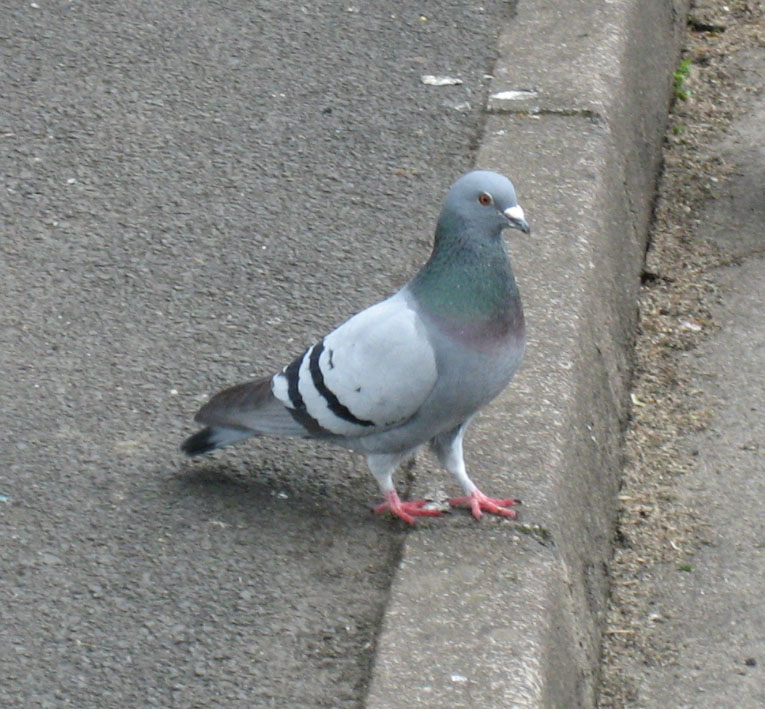
This is a rock dove. Scientific name Columba livia. Alias feral pigeon or flying rat. They are everywhere in New York City -- in our skies and our trees, under our feet and our air conditioners. But, like tourists and garbage and tall buildings, the average New Yorker barely recognizes their existence. As my friend so memorably stated in the quote immortalized above, we can go years on end without a single pigeon encounter.
Of course, I'm not so lucky. My love affair with these birds began at the ripe old age of five, when one of them shat on me while I was on my way to Kindergarten. And oddly enough, an unfortunate pigeon experience has heralded every new phase of my life ever since.
During my first year of high school, as I sat in a long-since-closed ice cream parlor in Queens with a few of my new friends, a pigeon flew into the shop, smashed into the plate-glass window above my head, knocked itself momentarily unconscious, and landed in my hair. To make matters worse, it got stuck in my rather wild curls when it revived and flapped around for a few moments before finding its way to the door.
Four years later, I began my education at the urban arm of the Ivy League and moved onto a campus full of pigeons with absolutely no fear of humans. They were constantly around my head, in my way, underfoot. I found myself swerving around campus to avoid them, which I thought was utterly ridiculous. One day, as a pigeon moseyed along in front of me as I tried to get to chemistry lecture, I began to wonder if the natural survival instinct ceased to exist in these birds. I pointed my foot, took aim, and gave the damned thing an experimental kick. Feathers scattered, it squawked and flew away. A hippie-looking girl crossing my path stopped and stared at me in abject horror. "Ohmygawd," she yelled, "animal cruelty!" I shrugged, told her the pigeon deserved it, and continued to class.
Four years later, I moved into the workforce and found myself on the upper east side. Yesterday, I got dressed up for work -- short pleated black skirt, black blouse, nude heels that make my legs look ten miles long -- and took a walk down First Avenue during my lunch break. I turned my head to check the traffic, faced forwards again... and spotted a pigeon about to collide, in-flight, with my chest. I raised my arms. It smacked into those instead, ricocheted back a foot, continued flying. I ran back to clinic as fast as my pretty heels could carry me and disinfected the upper half of my body with the same soap the MDs use to scrub into surgery.
Of course, this all leads me to wonder what's next. Watch the pigeons outnumber the guests on my wedding day.
Friday, August 15, 2008
Fool's Mate: Part III
For Part I, click here. For Part II, click here.
III. Endgame
"I won't look back any more... and if I do, just for a moment. I can't imagine a time when I won't care. But here we are today, and it's over! Hold me and tell me we'll meet again..." --Tim Rice, from Chess
Both players have given and taken everything they easily can. The board is bare, both kings are exposed. The pace of the game quickens but the moves become more focused. The players dance around each other, trying desperately to either end things swiftly or keep up the dance as long as possible.
A chess game can end in one of four ways. Wins and losses are the easy ones to characterize -- you either walk away with satisfaction and a higher rating or you walk away acknowledging that whatever you brought to the table wasn't good enough. One player leaves the game in a better place than before, while the other player leaves with a part of himself destroyed.
Draws are slightly more interesting, since they seem to defy the competitive spirit of the game. This is the chess equivalent of the mutual break-up -- when both players feel like they can't pull a satisfying win out of their situation, they simply shake hands, stand up, and walk away. No one wins, no one loses, and you can still remain friends afterwards.
Lastly, and most rarely, a chess game can end in a stalemate. Stalemates depend on two key rules of chess: it is illegal for a player to expose his own King to attack (also called "check"), and the game ends when a player's King is checked without a means of escape (also called "checkmate"). A stalemated position is one where a player's King is NOT in check, but every possible move on the board is illegal because it would result in check. A stalemate is an automatic draw -- no one wins and no one loses. The situation feels entirely different, though.
Sometimes a stalemate just happens -- you reach to move a piece and realize quite suddenly that there are no legal moves left. Other times, stalemates are engineered by sneaky players who are guaranteed losses otherwise. Once they sense defeat, they move with the sole intent of working themselves into a position where it is impossible for their partners to properly end the game. Some people can trick opponents into stalemates with astounding ease; I've only ended a game in a stalemate once during my entire chess career, but I know some players who are masters at it.
During the last game of his world championship match against Freddie -- a game which he seems poised to win -- Anatoly is given an ultimatum. He can keep Florence and his freedom if he wins the game, but both governments promise to make life hell for Florence's family and Anatoly's estranged wife and children if he dares. If he throws the game, he must leave Florence and return to Russia in exchange for the ensured safety of everyone in his life.
Ultimately, what choice does Anatoly make? In a true representation of the uncertainty of life, love, and the game of chess, the ending of the musical is continually rewritten. Sometimes Anatoly wins, sometimes he loses, sometimes he does neither. The outcome of the game changes with every production of the musical.
Of course, one ending is closer to my heart than all the others. Out of perceived obligation, Anatoly gives into Freddie. He throws the game, believing that he is acting in Florence's best interests, fully knowing that he has surrendered his own freedom and happiness to secure hers.
When Anatoly and Florence meet after the match, they fall into each other's arms and reflect on the choice he's made and the happy ending they always knew they could never truly experience. Their time together is limited, though, since deportation is a consequence of Anatoly's loss. His wife and several Russian officials wait in the wings to reclaim him.
Anatoly kisses Florence goodbye and walks out of her life without a backwards glance. Alone onstage, she pauses, wipes away a tear, and, in a trembling voice, sings lyrics previously delivered by Anatoly's neglected wife:
Wasn't it good? Wasn't he fine? Isn't it madness...?
Her voice trails off and she weeps openly. Her heart is broken, her life is in shambles, her cultural identity is lost. She is left with nothing except her memories... but suddenly, blindingly, she realizes that's all she needs to rebuild her existence. The orchestra swells. Florence sings again, but this time her words are Anatoly's. She belts his "Anthem" from the first-act finale, but she fits it with sentiments entirely her own:
How can I live now? Where do I start? Let man's petty nations tear themselves apart! My land's only borders lie around my heart!
For once in her life, Florence is her own woman. And though Anatoly joins her in singing the show's final lyrics, you must listen carefully to even notice that he's there. Anatoly may lose the game, but strangely, beautifully, I can't decide whether Florence wins, loses, draws, or stalemates.
III. Endgame
"I won't look back any more... and if I do, just for a moment. I can't imagine a time when I won't care. But here we are today, and it's over! Hold me and tell me we'll meet again..." --Tim Rice, from Chess
Both players have given and taken everything they easily can. The board is bare, both kings are exposed. The pace of the game quickens but the moves become more focused. The players dance around each other, trying desperately to either end things swiftly or keep up the dance as long as possible.
A chess game can end in one of four ways. Wins and losses are the easy ones to characterize -- you either walk away with satisfaction and a higher rating or you walk away acknowledging that whatever you brought to the table wasn't good enough. One player leaves the game in a better place than before, while the other player leaves with a part of himself destroyed.
Draws are slightly more interesting, since they seem to defy the competitive spirit of the game. This is the chess equivalent of the mutual break-up -- when both players feel like they can't pull a satisfying win out of their situation, they simply shake hands, stand up, and walk away. No one wins, no one loses, and you can still remain friends afterwards.
Lastly, and most rarely, a chess game can end in a stalemate. Stalemates depend on two key rules of chess: it is illegal for a player to expose his own King to attack (also called "check"), and the game ends when a player's King is checked without a means of escape (also called "checkmate"). A stalemated position is one where a player's King is NOT in check, but every possible move on the board is illegal because it would result in check. A stalemate is an automatic draw -- no one wins and no one loses. The situation feels entirely different, though.
Sometimes a stalemate just happens -- you reach to move a piece and realize quite suddenly that there are no legal moves left. Other times, stalemates are engineered by sneaky players who are guaranteed losses otherwise. Once they sense defeat, they move with the sole intent of working themselves into a position where it is impossible for their partners to properly end the game. Some people can trick opponents into stalemates with astounding ease; I've only ended a game in a stalemate once during my entire chess career, but I know some players who are masters at it.
During the last game of his world championship match against Freddie -- a game which he seems poised to win -- Anatoly is given an ultimatum. He can keep Florence and his freedom if he wins the game, but both governments promise to make life hell for Florence's family and Anatoly's estranged wife and children if he dares. If he throws the game, he must leave Florence and return to Russia in exchange for the ensured safety of everyone in his life.
Ultimately, what choice does Anatoly make? In a true representation of the uncertainty of life, love, and the game of chess, the ending of the musical is continually rewritten. Sometimes Anatoly wins, sometimes he loses, sometimes he does neither. The outcome of the game changes with every production of the musical.
Of course, one ending is closer to my heart than all the others. Out of perceived obligation, Anatoly gives into Freddie. He throws the game, believing that he is acting in Florence's best interests, fully knowing that he has surrendered his own freedom and happiness to secure hers.
When Anatoly and Florence meet after the match, they fall into each other's arms and reflect on the choice he's made and the happy ending they always knew they could never truly experience. Their time together is limited, though, since deportation is a consequence of Anatoly's loss. His wife and several Russian officials wait in the wings to reclaim him.
Anatoly kisses Florence goodbye and walks out of her life without a backwards glance. Alone onstage, she pauses, wipes away a tear, and, in a trembling voice, sings lyrics previously delivered by Anatoly's neglected wife:
Wasn't it good? Wasn't he fine? Isn't it madness...?
Her voice trails off and she weeps openly. Her heart is broken, her life is in shambles, her cultural identity is lost. She is left with nothing except her memories... but suddenly, blindingly, she realizes that's all she needs to rebuild her existence. The orchestra swells. Florence sings again, but this time her words are Anatoly's. She belts his "Anthem" from the first-act finale, but she fits it with sentiments entirely her own:
How can I live now? Where do I start? Let man's petty nations tear themselves apart! My land's only borders lie around my heart!
For once in her life, Florence is her own woman. And though Anatoly joins her in singing the show's final lyrics, you must listen carefully to even notice that he's there. Anatoly may lose the game, but strangely, beautifully, I can't decide whether Florence wins, loses, draws, or stalemates.
Sunday, August 10, 2008
Assed from the Past
"If Dr. Seuss had an arse as painful as mine..." -- Yours Truly, circa 2002
I threw out all of my old High School notebooks (except for AP Bio, of course) tonight. While rifling through years' worth of old papers, I found this gem of poetry scribbled on the back of an AP Euro DBQ source document. Honestly, I surprise myself sometimes.
I set off down the hall
Interrupted by a balk.
I stumble but don't fall.
I'm limping when I walk.
My backside really aches --
It's stiff when I sit down.
It hurts, for goodness sake!
You wonder why I frown!
You wonder why I frown --
It hurts, for goodness sake!
It's stiff when I sit down,
My backside really aches.
I'm limping when I walk.
I stumble but don't fall.
Interrupted by a balk,
I set off down the hall.
I threw out all of my old High School notebooks (except for AP Bio, of course) tonight. While rifling through years' worth of old papers, I found this gem of poetry scribbled on the back of an AP Euro DBQ source document. Honestly, I surprise myself sometimes.
I set off down the hall
Interrupted by a balk.
I stumble but don't fall.
I'm limping when I walk.
My backside really aches --
It's stiff when I sit down.
It hurts, for goodness sake!
You wonder why I frown!
You wonder why I frown --
It hurts, for goodness sake!
It's stiff when I sit down,
My backside really aches.
I'm limping when I walk.
I stumble but don't fall.
Interrupted by a balk,
I set off down the hall.
Tuesday, August 5, 2008
Sweet and Sour
"For a candied sweet or a pickled beet, step up to my smorgasbord. Walk around until you get your fill. Baby, you won't ever be bored!" -- Comden and Green, from On the Town
A few weeks ago, my dear friend Red introduced me to Chocolate Chipped, an incredible dessert blog that never fails to trigger my sweet tooth. They featured this recipe for vegan white chocolate lime cookies the other day, which I absolutely couldn't resist testing out. Between us -- and I can almost hear the cries of countless Italians across two continents just by thinking this -- I actually enjoy vegan baking. It came in handy in college when I never kept eggs around and it's about as health-conscious as desserts can get.
That didn't prevent me from completely de-veganizing the recipe before I attempted it, though! See below for my full-fat, animal-products-galore version of the recipe, which turned out a batch of gorgeous cookies. I don't usually like white chocolate, but combining it with lime results in a unique, refreshing, and altogether delicious flavor.
White Chocolate Lime Cookies
(Adapted from a recipe by Celine of Have Cake, Will Travel)
1/2 stick of softened butter
2 heaping tbsp brown sugar
3 tsp (or packets) sugar-in-the-raw
Zest and juice of half of one large lime
1/2 tsp vanilla extract
3/4 cup flour
1/2 tsp baking powder
1/4 cup white chocolate chips
1 tbsp whole milk
Preheat oven to 350 degrees. Beat butter, sugar, lime juice and zest, and vanilla until light and fluffy. Add flour, baking powder, vanilla, milk, and chocolate chips and mix by hand until the batter holds together. Drop batter by the teaspoonful (for small cookies) or tablespoonful (for large cookies) onto a parchment- or foil-covered cookie sheet. Flatten each ball of dough to desired cookie thickness before baking, since the batter will not spread in the oven. Bake for 15 minutes or until the edges have started to brown. Makes 10 large cookies or 20 small cookies.
A few weeks ago, my dear friend Red introduced me to Chocolate Chipped, an incredible dessert blog that never fails to trigger my sweet tooth. They featured this recipe for vegan white chocolate lime cookies the other day, which I absolutely couldn't resist testing out. Between us -- and I can almost hear the cries of countless Italians across two continents just by thinking this -- I actually enjoy vegan baking. It came in handy in college when I never kept eggs around and it's about as health-conscious as desserts can get.
That didn't prevent me from completely de-veganizing the recipe before I attempted it, though! See below for my full-fat, animal-products-galore version of the recipe, which turned out a batch of gorgeous cookies. I don't usually like white chocolate, but combining it with lime results in a unique, refreshing, and altogether delicious flavor.
White Chocolate Lime Cookies
(Adapted from a recipe by Celine of Have Cake, Will Travel)
1/2 stick of softened butter
2 heaping tbsp brown sugar
3 tsp (or packets) sugar-in-the-raw
Zest and juice of half of one large lime
1/2 tsp vanilla extract
3/4 cup flour
1/2 tsp baking powder
1/4 cup white chocolate chips
1 tbsp whole milk
Preheat oven to 350 degrees. Beat butter, sugar, lime juice and zest, and vanilla until light and fluffy. Add flour, baking powder, vanilla, milk, and chocolate chips and mix by hand until the batter holds together. Drop batter by the teaspoonful (for small cookies) or tablespoonful (for large cookies) onto a parchment- or foil-covered cookie sheet. Flatten each ball of dough to desired cookie thickness before baking, since the batter will not spread in the oven. Bake for 15 minutes or until the edges have started to brown. Makes 10 large cookies or 20 small cookies.
Saturday, August 2, 2008
Fool's Mate: Part II
(Click here for Part I: Opening Combination)
II. Middlegame
"Though I'd move my world to be with him, still the gap between us is too wide. Looking back, I could have played it differently... won a few more moments, who can tell? But it took time to understand the man. Now at least I know I know him well." -- Tim Rice, from Chess
You shake hands with your partner and both of you take a seat. You make a move, he reacts, you react to his reaction. You keep offering possibilities. So does he. You feed off of each other, more connections are made, more possible outcomes are offered with every response. You fortify your position, refine your focus, and your partner does the same. You watch his movements carefully in search of what he's thinking, what he's longing to do to you. Then, at any given moment, one of you finally strikes. He takes, you take, he takes again, and the exchange continues until the position is spent. You pause, you take a breath. Things slow down. The rules of the game are completely different now and so is the board in front of you, so you must reassess where you stand in terms of both.
Daters call the next phase of this game a steady relationship, but to chess players, it's the middlegame. In both cases, its boundaries are pretty ill-defined and vary from player to player. Some people think the middlegame starts once the textbook opening combination ends, but others, including me, think that the rapid-fire exchange of captures that inevitably follows every opening is the true mark of the middlegame. After this point, both of you have committed to the game, you've exchanged parts of yourself, and you're willing to navigate the new board arrangement together. And though one player may enter the middlegame with a bit of an advantage in terms of captured pieces or position, the players are always on pretty even footing if the pairing is well-matched.
Once again, my middlegame style reflects my personality with astounding accuracy. The middlegame has always been the strongest part of my gameplay because it depends on imagination as much as it depends on strong tactical skill. I have enough tricks up my sleeve to give my partner everything he could ever want in a game, and I can use them creatively enough to keep the game interesting. I'm good at keeping an open, centralized position and moving with both subtlety and decisiveness. All of my exchanges – and the middlegame almost completely depends on smart trades between players – are thought-out and innovative. I'm not afraid to pin pieces, make sacrifices, or surrender position if I know that it will make the game better in the long run. I screw myself over more often than not while playing chess, but it very rarely happens in this phase of the game.
How does the middlegame pan out for Florence and Anatoly? They fortify their positions and defeat Freddie at the World Championship. They complement each other perfectly; Anatoly's love gives Florence the strength to sever all ties with Freddie, and Florence's love gives Anatoly the strength to leave his oppressive government. They both give, they both take, and they both navigate the middlegame with even material and positions. By the time the middlegame finishes, the board is clear of all pieces but a few. The best line of play for both of them seems obvious, but Florence's family, Anatoly's family, Anatoly's career, the national-scale baggage of both players, and, of course, the constant meddling of Freddie complicate matters. When we enter the endgame, Anatoly has a choice to make. He can either remain with Florence at the cost of his perceived honor or give into Freddie at the cost of his own happiness.
To be continued in Part III.
Subscribe to:
Posts (Atom)


 Posts
Posts


